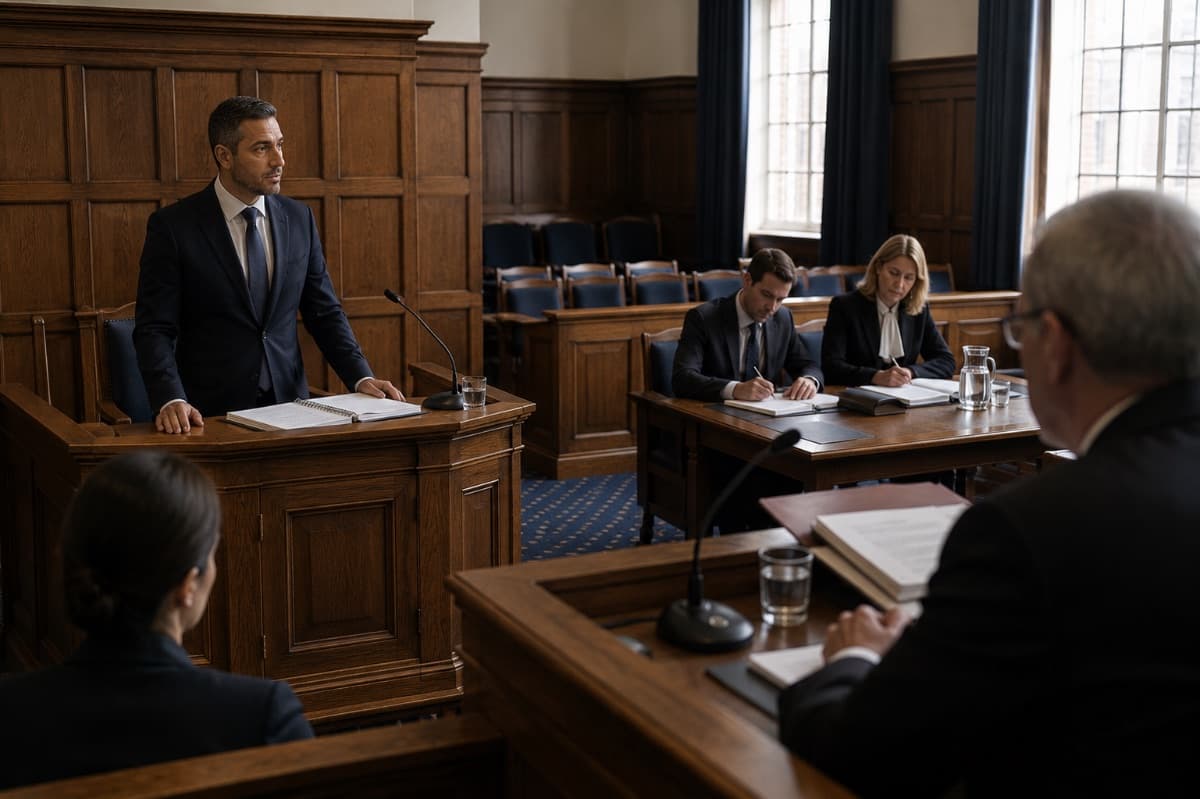

Every day, judges, prosecutors and institutions across the Middle East and North Africa ask psychiatrists questions that are not purely clinical. Was this person responsible for what they did? Are they fit to stand trial? Do they have the capacity to manage their own affairs? Which arrangement is best for the child?
The answers affect people's liberty, families and livelihoods. Yet most of the clinicians asked to give them were never taught how.
A question clinical training does not answer
Psychiatric training in the region is strong on diagnosis and treatment. It says far less about what happens when a clinical opinion enters a legal process.
A legal question is different from a clinical one. A court does not ask "What is the diagnosis?" It asks whether a legal test is met, and it expects an opinion that is reasoned, stays within the expert's field and holds up when challenged.
Without training, capable clinicians make the same avoidable errors:
A report that describes the patient but never answers the question asked.
An opinion that goes further than the evidence supports.
A conclusion that is hard to defend under questioning in court.
Why the gap exists
Forensic psychiatry is still a young specialty in most of the region. Structured training is available in a small number of centres. Elsewhere, clinicians learn through experience, and often alone.
Most established teaching material was written in English, for other legal systems, and does not map directly onto local law. The two professions also rarely train together. Doctors learn little about how courts reason. Judges and lawyers learn little about what psychiatry can and cannot say.
The problem is not a shortage of talent. It is a shortage of structured training.
Why I founded MedLex
I trained and practised in the United Kingdom, where medico-legal work is taught, supervised and assessed. Working in the region, I saw able colleagues face the same questions without that support. MedLex is the response.
MedLex is a professional education platform built on 3 principles:
Method before statute. We teach how to read the legal question, build an opinion, write the report and give evidence. English law is our reference framework, adapted to the law of the country where each group practises.
Practical, case-based learning. Participants work through realistic cases and leave with skills they can apply directly in their work.
Arabic and English. Professionals learn best in the language they work in.
We are an education platform only. We do not write reports or give evidence in court. We train the professionals who do.
When a psychiatric opinion reaches a courtroom, someone's future rests on its quality. That quality can be taught.
Our first medico-legal programme, Writing Psychiatric Evidence, is coming soon. Join the waitlist on the Medico-Legal pathway page.